





We are getting very good at generating things. Images, text, ideas. Faster, sharper, almost without effort. What used to take hours now takes seconds and in many cases, the result is good enough.
And yet, the more everything becomes seamless, the more we start noticing what is not.
Not in a nostalgic way, but in a very present one. There is a growing attention toward objects that do not look optimized, pieces that carry small inconsistencies, materials that behave in ways you cannot fully predict. In other words, things that feel made.
The value of handmade objects today
Craftsmanship does not try to compete with speed and it does not need to. It operates on a completely different logic.
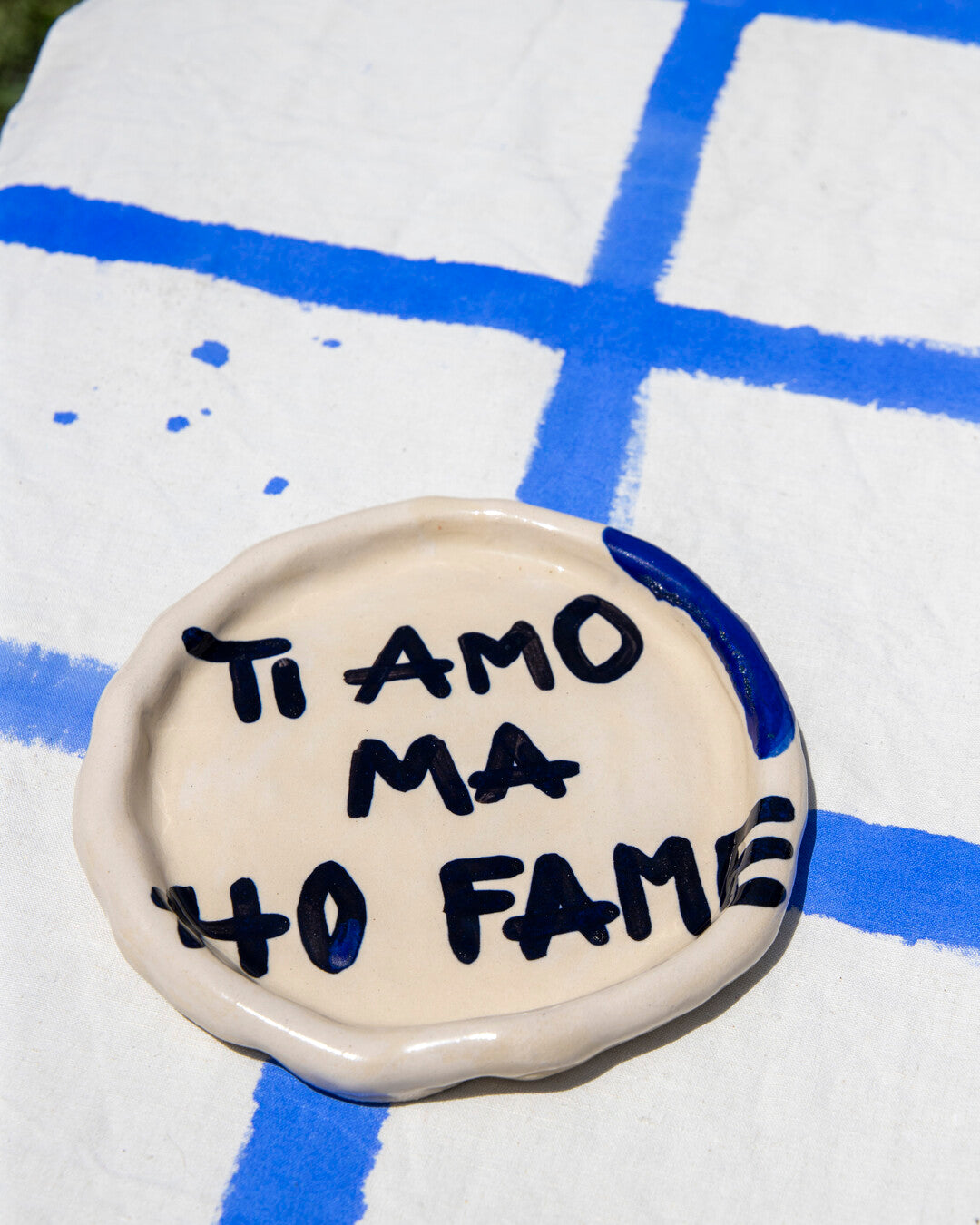
A handmade object is not just the result of a process, it is the record of it. You see it in the way a glaze reacts in the kiln, in the tension of a textile, in the slight variation between two pieces that were never meant to be identical.
These are not imperfections to fix, but qualities to preserve.
In a landscape where objects can be reproduced endlessly, uniqueness becomes something tangible again. Not as a concept, but as a physical characteristic.
 |
A.I. NON INCLUSA: a closer look at contemporary craft
This perspective takes shape in A.I. NON INCLUSA, an exhibition that brings together contemporary craft practices across ceramics, textile art and mixed media.
The focus is simple but relevant. What happens when the process cannot be automated?
What emerges is a different relationship with time and material. There is no instant output, no shortcut to the final result. Each piece depends on repetition, adjustment and decision making that happens in real time.
That difference is visible.
In Latency: when time becomes part of the work
In Latency revolves around the idea of delay.
In digital systems, latency is something to eliminate, a gap between input and output that slows everything down. Here, it becomes the core of the work.
The textile surface does not reveal itself immediately. It requires a slower way of looking, one that does not rely on instant readability. The result is a piece that feels grounded, not because it is complex, but because it resists immediacy.
 |
Arizona Tapestry: repetition as structure
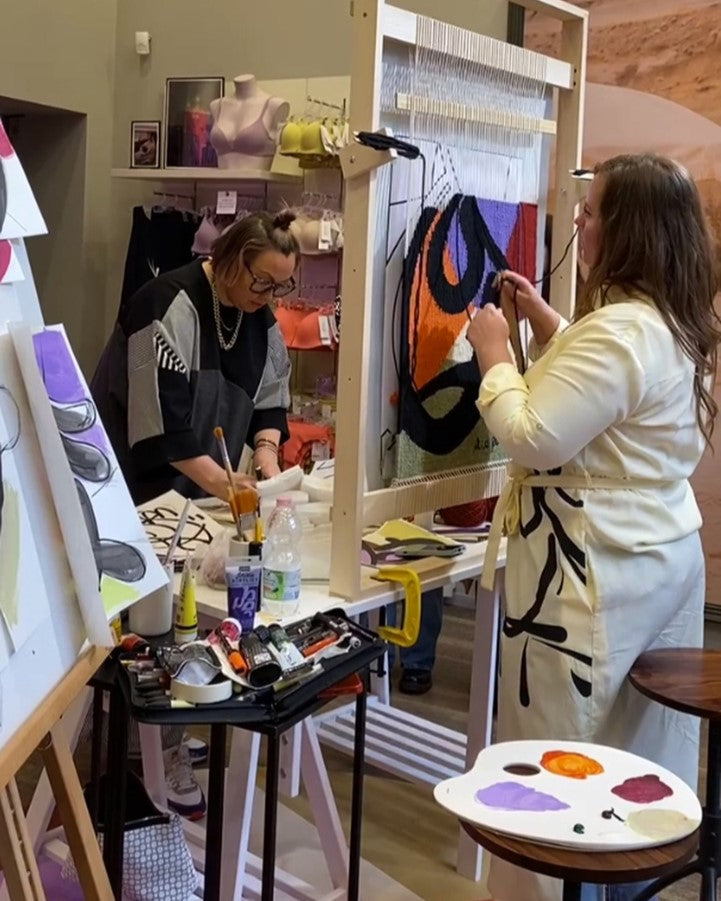
With Arizona Tapestry, weaving becomes a way of building space.
The work grows through repetition, but the repetition is never mechanical. Each gesture accumulates into a larger structure that defines how the piece exists in its environment.
You do not just look at it, you move around it and in doing so you become aware of the time embedded in it.
This is what textile art does at its best. It makes process visible.
 |
Caramella: familiar, but not quite
At first glance, Caramella feels recognizable.
There is something soft, almost playful in its form, something that suggests a known reference.
But the longer you look at it, the less fixed that reference becomes. The object shifts between what it seems and what it is, leaving space for interpretation.
That ambiguity is not a side effect. It is part of the making. Craft does not always aim to define. Sometimes it opens a question.
 |
Contrasto Silenzioso: tension as balance
Contrasto Silenzioso is built on contrast but not in a dramatic way.
The tension between materials is subtle, held in place rather than resolved.
Rope and textile interact without hierarchy. The structure exists because these elements support each other, not because they are forced into uniformity.
It is a quiet reminder that balance does not come from sameness, but from the coexistence of differences.
 |
Flames: when form takes over
With Flames, the ceramic object moves beyond function.
It does not behave like a container or a decorative piece in the traditional sense. Instead, it expands into something more expressive.
The surface is irregular, the form almost unstable. It suggests movement, growth and a certain resistance to control.
Working with clay means accepting that the material has its own logic. The final result is not imposed, but negotiated.
|
|

Vasi Volto: when objects look back
With Vasi Volto, the object stops being neutral.
Faces emerge from the surface, shifting the relationship between object and observer.
You are no longer just looking at it. In a way, it looks back.
 |
Craftsmanship beyond nostalgia
It is tempting to frame all of this as a reaction to technology, but that would be too simple.
Craftsmanship today is not about going backwards. It is about introducing a different way of valuing objects.
One that prioritizes uniqueness over replication, cultural diversity over standardization, and awareness over speed. These are not abstract ideas. They are embedded in the objects themselves.
And increasingly, they are what people are looking for.
A.I. NON INCLUSA brings together works by the artists and makers Spaghetti Rugs, BRAIDA, Lorac Ceramics, Elisabetta d’Arienzo, Nathan Viva Ceramics, Niho Ceramics, Circe Ceramiche, Silvia Di Piazza, Mariadela Araujo, each exploring materials, process and time in their own way.
You can visit the exhibition until May 31 at Settimo Cielo Retail Park, at Settimo Torinese (TO).
Opening hours are Thursday and Friday from 12 to 2pm and from 5 to 7pm, and Saturday, Sunday and May 1st from 11am to 7pm.
Free entry.